J&K Power Tariff Hike Sparks Political Storm: Opposition Calls It a “Betrayal” of 200-Unit Free Electricity Promise
By: Javid Amin | 22 Aug 2026
J&K power tariff hike | 6.83% electricity tariff increase | 200 units free electricity | Omar Abdullah government | JERC tariff 2026
The electricity bill in Jammu and Kashmir has suddenly become a political bill as well.
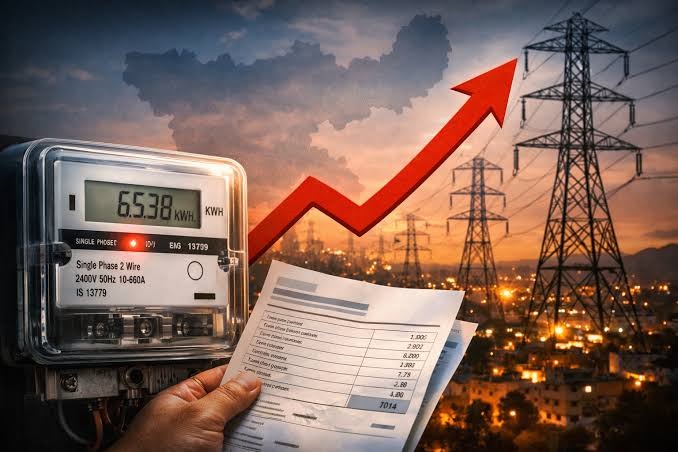
The Joint Electricity Regulatory Commission (JERC) has approved an average 6.83% increase in electricity tariffs, with the revised rates applying to consumption from September 1, 2026. The decision has triggered sharp criticism from opposition parties, which argue that the National Conference-led government is asking people to pay more after coming to power on promises of substantial relief, including 200 units of free electricity.
The strongest criticism has come from BJP Leader of Opposition Sunil Sharma, PDP leader Waheed-ur-Rehman Para, Peoples Conference chief Sajad Gani Lone and Apni Party president Altaf Bukhari.
But there is an important distinction often lost in the political debate: JERC—not the NC government—approved the tariff revision, while the J&K government has committed substantial subsidy support to keep the increase considerably below what would otherwise have been required.
That does not make the political controversy disappear.
It makes it more complicated.
The Political Flashpoint: From “200 Units Free” to Higher Bills
For opposition parties, the chronology is difficult to ignore.
The National Conference’s 2024 election campaign included a promise of 200 units of free electricity. Nearly two years later, consumers are being told that electricity tariffs will increase from September.
BJP Leader of Opposition Sunil Sharma described the decision as a betrayal of public trust, arguing that the government had promised free electricity but consumers are instead facing higher bills.
PDP MLA Waheed Para made a similar argument, saying the increase comes when unemployment, inflation and household financial pressures are already weighing heavily on ordinary families. He questioned what had happened to the promise of free electricity.
Sajad Lone went further, calling the increase a “shock” for consumers who had been promised 200 free units in 2024. He also alleged that consumers in non-metered areas had faced increased assessed loads, adding to their monthly bills.
Altaf Bukhari also criticised the move, arguing that households were already dealing with economic pressures affecting sectors such as tourism and horticulture.
The political message is therefore simple:
People were promised relief. They are now being asked to pay more.
But whether that amounts to a broken promise is a more complicated question.
What JERC Actually Decided
The first fact that needs to be separated from the politics is the regulatory decision itself.
JERC approved an average 6.83% tariff increase for Jammu and Kashmir for 2026–27.
The new tariff applies to electricity consumed from September 1, 2026, and is presently applicable through March 31, 2027, unless the Commission modifies, extends or replaces the order.
The increase affects the tariff structures of:
- Jammu Power Distribution Corporation Limited (JPDCL)
- Kashmir Power Distribution Corporation Limited (KPDCL)
Interestingly, the utilities themselves had sought only a 5% across-the-board increase.
JERC ultimately approved a higher average revision of 6.83% after examining the utilities’ revenue requirements.
That point is important because the present political narrative sometimes gives the impression that the government itself simply decided to raise electricity prices.
Legally and institutionally, that is not what happened.
The tariff was approved by the electricity regulator.
Why Did JERC Approve a Hike?
Behind the political controversy sits a very serious financial problem.
According to the JERC order, the combined Annual Revenue Requirement (ARR) of JPDCL and KPDCL, after the Commission’s prudence assessment, was determined at approximately ₹10,275.72 crore.
At existing tariffs, the utilities were expected to recover only around ₹7,352.87 crore.
That created a gap of approximately:
₹2,922.85 crore.
JERC calculated that recovering the entire deficit through consumer tariffs would have required an increase of roughly 40%—something the Commission described as a tariff shock.
Instead, the regulator adopted a mixed approach.
The tariff was increased moderately, while the government committed substantial financial support.
The ₹2,420 Crore Subsidy Changes the Picture
The J&K government has committed approximately ₹2,420.78 crore in financial support under Section 65 of the Electricity Act, 2003.
After the revised tariff, the utilities’ projected revenue rises to about ₹7,854.94 crore, while the remaining gap is to be met through government grant-in-aid.
This is perhaps the most important economic fact missing from the slogan-driven debate.
The government has not abandoned electricity subsidies.
Instead, the present model is essentially:
Consumer tariff + government subsidy = utility revenue requirement.
In fact, without the government subsidy, consumers could theoretically have faced a dramatically larger tariff increase.
So the question is not simply:
“Why has the government increased electricity prices?”
It is also:
“How much of J&K’s electricity cost should be paid by consumers, and how much should be paid from the public exchequer?”
That is a legitimate policy debate.
But Where Is the “200 Units Free” Electricity?
This is where political messaging and policy design have become tangled.
The phrase “200 units free” can easily be understood as meaning that every household would automatically receive its first 200 units of grid electricity free of charge.
The programme that moved toward implementation in 2026, however, was structured around targeted rooftop solarisation of Antyodaya households, rather than a universal monthly waiver on ordinary grid bills.
In February 2026, the Centre approved a project covering roughly 2.23 lakh Antyodaya Anna Yojana households, with rooftop solar systems expected to generate around 200 units per month under the PM Surya Ghar Utility-Led Aggregation model.
That distinction matters.
It means the government’s earlier 200-unit initiative and the new JERC tariff order are not technically the same policy.
The solar programme aims to reduce or eliminate electricity expenditure for targeted vulnerable households through generation.
The JERC order determines the price of electricity supplied through the distribution system.
So, Is the Opposition Wrong?
Not entirely.
The opposition has a politically valid argument if voters understood the 200-unit promise as a broader immediate electricity-bill relief measure.
After all, the public experience is what matters politically.
A household that hears “200 units free” may reasonably expect its electricity bill to fall.
If that same household later receives a higher bill, the government will naturally face questions.
Sajad Lone captured this political contradiction when he argued that people who had been promised free power are now being asked to pay more.
Waheed Para similarly framed the tariff increase against the backdrop of the government’s broader election promises.
So the criticism cannot simply be dismissed.
But there is also a factual limit to the opposition narrative.
It would be inaccurate to say that the government has formally cancelled the 200-unit solarisation programme merely because JERC approved a tariff increase.
These are different mechanisms.
The Government’s Difficult Defence
The NC government has a strong economic argument available to it.
Electricity distribution cannot remain financially viable indefinitely if utilities recover substantially less than the cost of supplying power.
J&K’s power sector has long struggled with:
- high power procurement costs;
- distribution losses;
- infrastructure deficiencies;
- billing and collection challenges;
- seasonal demand fluctuations;
- dependence on purchased electricity.
The JERC order itself demonstrates the size of the financial imbalance.
A nearly ₹2,923 crore gap between assessed revenue requirements and revenue at existing tariffs cannot simply disappear.
Someone must pay for it.
That “someone” can be:
- consumers through higher tariffs;
- the government through subsidies;
- utilities through accumulated deficits;
- or, ultimately, taxpayers through public finances.
The current decision spreads the burden between consumers and government.
Is 6.83% Really a 6.83% Increase for Every Household?
No.
This is another point that needs clarification.
The 6.83% figure is an average tariff increase, not a flat 6.83% increase on every electricity bill.
For metered domestic consumers, the revised energy charges are reported at:
| Consumption | Revised energy charge |
|---|---|
| Up to 200 units | ₹2.45/unit |
| 201–400 units | ₹4.20/unit |
| Above 400 units | ₹4.60/unit |
| Fixed charge | ₹10/kW/month |
Certain concessional categories, including BPL households and small agricultural consumers, have retained preferential rates.
Therefore, the actual increase in an individual bill depends on:
- consumption;
- category;
- sanctioned load;
- fixed charges;
- subsidy;
- and applicable tariff provisions.
A consumer should therefore not simply multiply the old bill by 1.0683 to estimate the new bill.
Middle-Class Families Are at the Centre of the Political Anger
The middle class occupies an uncomfortable position in electricity policy.
It often does not qualify for the deepest welfare subsidies.
At the same time, electricity consumption can be significant.
In Kashmir, winter heating and household appliances can push consumption upward.
In Jammu, summer cooling requirements can have the same effect.
Families moving into higher consumption slabs will therefore feel the increase more clearly.
For a household already dealing with:
- school fees;
- healthcare expenses;
- food inflation;
- transportation costs;
- rent or housing loans;
- and other household expenses,
even a relatively modest increase in utility bills can become politically sensitive.
This is why electricity tariffs rarely remain an ordinary regulatory issue.
They quickly become a cost-of-living issue.
Small Businesses Could Feel the Pressure Too
The impact does not stop at household consumers.
Small businesses operate on thin margins.
A bakery needs ovens and refrigeration.
A restaurant needs lighting, refrigeration, ventilation and kitchen equipment.
A hotel needs heating, hot water, laundry and other electrical systems.
A workshop depends on machinery.
A cold-storage facility is almost entirely dependent on reliable electricity.
For such enterprises, electricity is not merely a monthly household expense.
It is an input cost.
If electricity becomes more expensive, businesses eventually face three choices:
Absorb the cost
Profit margins shrink.
Cut consumption
Operations may suffer.
Pass the cost to customers
Prices increase.
That makes the tariff issue relevant to the wider J&K economy.
Tourism and Horticulture Add Another Layer
Opposition leaders have specifically pointed to pressures on tourism and horticulture.
The tourism sector is especially sensitive to utility costs because accommodation providers consume electricity for heating, hot water, refrigeration, kitchens, lighting and other services.
A tariff increase may therefore feed indirectly into room prices and operating expenses.
Horticulture has a different relationship with electricity, particularly where irrigation, cold storage, grading and post-harvest infrastructure are involved.
For an economy already trying to expand private investment and employment, the government must therefore be careful about how much additional cost it places on productive sectors.
Jammu vs Kashmir: Is There a Regional Dimension?
Some political criticism has attempted to introduce a regional angle, suggesting Jammu consumers could be disproportionately affected.
That claim requires caution.
The JERC order applies to the electricity distribution system across Jammu and Kashmir, and the tariff revision itself is not presented as a Jammu-versus-Kashmir policy.
However, regional economic conditions differ.
Electricity consumption patterns are different.
Climate-driven demand is different.
Industrial structures are different.
Commercial activity is different.
The prevalence of metered and non-metered connections can also influence individual experiences.
Therefore, while the tariff order itself is broadly applicable, its economic consequences can vary significantly between regions and consumer groups.
That is a better way to understand the Jammu-Kashmir dimension than treating the hike automatically as a regional discrimination issue.
The “Betrayal of Trust” Argument Is Bigger Than Electricity
What makes this controversy politically potent is not merely the amount added to the electricity bill.
It is expectation.
Election promises create an implicit contract between political parties and voters.
When a party promises a major economic benefit, people may make decisions based on the expectation that the promise will materialise.
If implementation is delayed, altered or redesigned, disappointment can become stronger than the actual financial impact.
That is exactly what is happening with the electricity debate.
The opposition is not merely saying:
“Electricity is now more expensive.”
It is saying:
“You promised electricity relief and delivered a tariff increase instead.”
That is a much more powerful political argument.
But There Is Another Side to the “Betrayal” Narrative
A tariff increase approved by JERC does not automatically prove that the NC government deliberately broke its election promise.
The regulator operates within its statutory framework.
The J&K government has also committed ₹2,420.78 crore in subsidy support, specifically reducing the amount that would otherwise have had to be recovered from consumers.
And the 200-unit initiative was linked to targeted rooftop solarisation rather than simply making 200 grid units universally free for every household.
Therefore, a more accurate description would be:
The political promise and the current tariff structure appear contradictory to many consumers, but the regulatory and subsidy mechanisms show that the government has not simply replaced a universal free-power scheme with a tariff hike.
That nuance matters.
What the Government Must Explain Now
If the NC government wants to neutralise the political damage, simply saying that the tariff increase was unavoidable will probably not be enough.
It should clearly publish:
1. Who qualifies for the 200-unit solar benefit?
Consumers need a simple eligibility list.
2. How many rooftop systems have actually been installed?
Approval is not implementation.
3. When will beneficiaries start receiving the benefit?
A timeline would remove uncertainty.
4. What will happen to households outside the AAY category?
This is particularly important because many middle-class families may not qualify.
5. How will the ₹2,420.78 crore subsidy be utilised?
Transparency over the subsidy would strengthen public confidence.
6. What efficiency improvements are being demanded from KPDCL and JPDCL?
Consumers should not be expected to continuously pay more without seeing improvements in service and financial efficiency.
The Bigger Issue: Who Should Pay for J&K’s Electricity?
This is ultimately not a simple NC-versus-opposition argument.
It is a question every government in J&K will eventually have to answer.
Should electricity be treated primarily as:
a welfare entitlement?
Or:
an economically priced public utility?
There is a legitimate case for subsidising vulnerable families.
There is also a legitimate case for recovering a greater share of electricity costs from consumers who can afford to pay.
The problem begins when subsidies become universal, permanent and fiscally unsustainable.
Equally problematic is aggressive tariff rationalisation without improving electricity supply and distribution efficiency.
The sustainable middle path is likely to involve:
targeted subsidies + renewable generation + better metering + lower distribution losses + improved collection + rational tariffs.
J&K’s Power Politics Has Entered a New Phase
The immediate political battle is about 6.83%.
The longer-term battle is about credibility.
For the opposition, the tariff increase offers an opportunity to revisit one of the NC’s most prominent election promises.
For the government, the challenge is to demonstrate that fiscal responsibility does not mean abandoning welfare commitments.
For JERC, the task is different: maintain a financially viable electricity sector while preventing tariff shocks.
And for consumers, the question is refreshingly simple:
Will they get more reliable electricity for the money they are being asked to pay?
That is the metric that will ultimately matter more than political slogans.
What Happens Next?
The tariff increase is scheduled to begin with electricity consumption from September 1, 2026.
The political pressure, however, has already begun.
Opposition parties are likely to continue demanding that the government explain the status of its 200-unit electricity commitment.
The government, meanwhile, will have to defend the economic rationale behind the tariff structure while demonstrating that subsidies and solarisation programmes are actually reaching intended beneficiaries.
The first few months after implementation could be crucial.
If consumers see only higher bills, the opposition’s “betrayal” narrative will gain traction.
If the government can demonstrate:
- functioning rooftop solar systems;
- targeted relief;
- better electricity supply;
- reduced losses;
- improved billing;
- and transparent subsidy utilisation,
the political argument may become considerably weaker.
Final Analysis: A Political Crisis Built Around a Regulatory Decision
The 6.83% J&K power tariff hike is now much more than an electricity-sector adjustment.
It has become a test of the National Conference government’s credibility.
The opposition has found a powerful contradiction between the language of the 2024 campaign and the reality facing consumers in September 2026. Sunil Sharma has called it a betrayal, Waheed Para has questioned the government’s free-power commitment, Sajad Lone has described the hike as a shock, and Altaf Bukhari has criticised the additional burden on consumers.
But the economic facts tell a more complicated story.
JERC says the utilities faced a substantial revenue gap and that recovering it entirely through tariffs could have required a roughly 40% increase. Instead, the Commission approved an average 6.83% increase while factoring in approximately ₹2,420.78 crore of government financial support.
So calling the episode simply a “free electricity promise turned into a tariff hike” is politically effective but economically incomplete.
The real test now is implementation.
Can J&K simultaneously protect vulnerable households, make its power utilities financially sustainable, expand rooftop solar and deliver better electricity service without repeatedly increasing the burden on ordinary consumers?
That is the question the government will ultimately have to answer—not merely to the opposition, but to the people who open their electricity bills every month.